Pillar four · Tips 16–20
How Coaching Happens
Turn observation, dialogue, modeling, rehearsal, and evidence into coaching that leads to a useful next move.
The practical question
What does a coach actually do?
Strong coaching is more than being supportive or sharing ideas. It is a sequence of purposeful moves that helps another educator see practice clearly, choose a focus, rehearse change, and learn from evidence.
Tip 16: Observations to Actionable Feedback
Collect narrow, useful evidence and connect it to one high-impact instructional move.
Try this: Name one observable pattern, then ask the teacher what they notice before offering a recommendation.
Tip 17: Coaching Cycles
Create a focused arc from goal-setting through evidence, practice, implementation, and reflection.
Try this: Choose one goal and map the next check-in before the conversation ends so the cycle has a visible arc.
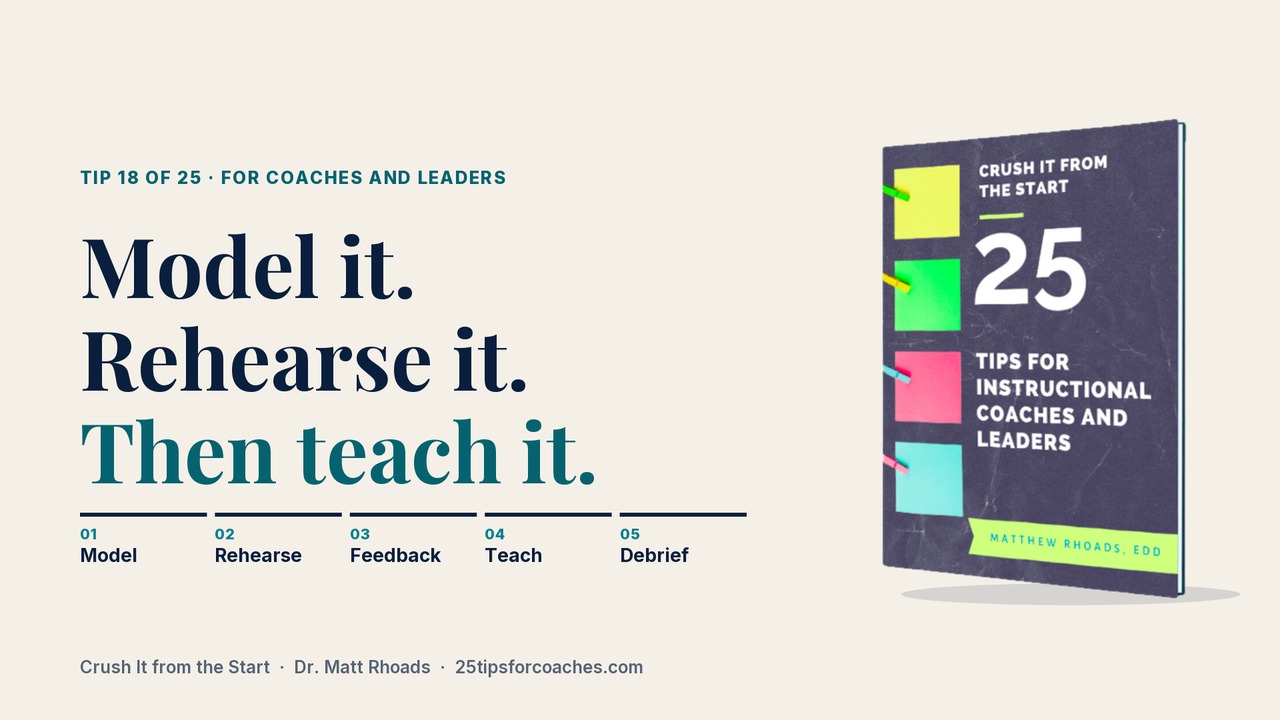
Tip 18: Modeling, Rehearsal, Practice, and Feedback
Make new practice visible, give teachers a safe place to rehearse, and refine the move together.
Try this: Model one small move, invite a low-stakes rehearsal, and give one cue before asking for another attempt.
Watch Tip 18: Model It, Rehearse It, Then Teach It
Watch Tip 18 in about a minute. A coach models Think, Write, Pair, Share while the teacher watches. The teacher rehearses one chunk, gets feedback, and runs it again before teaching it live. The debrief feeds the next rehearsal: a coaching cycle within a coaching cycle.
Video description
An animated explainer in navy, teal, and cream. A coach models Think, Write, Pair, Share as a teacher watches. The teacher rehearses, receives feedback, tries the move again, teaches it live while the coach observes, then debriefs to plan the next rehearsal.
Tip 19: Focus on Instruction – You Are Not a Therapist
Listen with care while keeping the conversation connected to instruction and student learning.
Try this: Acknowledge the person’s experience, then return to the instructional question and the student evidence you can act on.
Tip 20: Navigating Opposition and Coaching Styles
Match a facilitative, directive, or dialogical stance to the person, moment, and goal.
Try this: State the reason for your stance, invite the teacher into the decision, and shift direction when the evidence calls for it.
Continue with a practical tool
Choose the next coaching job: plan the conversation, turn evidence into feedback, rehearse a move, or reduce unnecessary cognitive load.

