
Today marks the release of my new book—a resource designed for instructional coaches, principals, assistant principals, college of education professors, and district office leaders who are committed to transforming teaching and learning in the modern classroom.
This book isn’t just about coaching strategies; it’s about understanding the content necessary to navigate education in the age of AI. To coach effectively, you must blend relationship-building, cognitive science, educational technology, coaching strategies, and systems thinking into a cohesive approach.
Learn more at 25tipsforcoaches.com
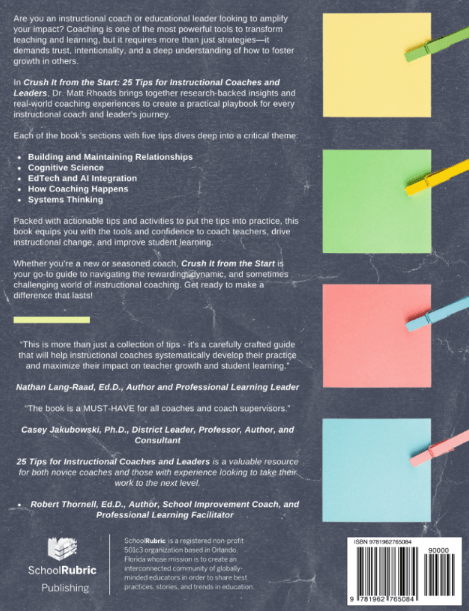
Each section of the book explores five actionable tips within a key theme:
Building and Maintaining Relationships
Great coaching starts with trust. Without strong relationships, even the best strategies won’t take hold. This section explores how to:
- Establishing Psychological Safety in Coaching – Create an environment where teachers feel supported, not judged.
- Develop Empathy as a Coaching Skill – Use active listening and emotional intelligence to foster real connections.
- Navigate Resistance to Change – Understand why teachers resist feedback and how to move past it.
- Shift from Evaluation to Partnership – Build coaching relationships that feel collaborative, not evaluative.
- Sustain Momentum Over Time – Keep teachers engaged in continuous learning, even after coaching cycles end.
The strongest instructional impact happens when teachers see coaches as allies, not evaluators. This section helps you build the foundation for trust-driven coaching.
Cognitive Science
To improve instruction, coaches must understand how learning works. This section dives into the science behind effective teaching so you can coach with evidence-based insights and practices:
- The Science of Memory and Retention – Teach in ways that align with how the brain encodes and retrieves information.
- Cognitive Load Theory – Help teachers design lessons that minimize overwhelm and maximize deep learning.
- Retrieval Practice and Spaced Repetition – Guide teachers to use strategies that reinforce long-term learning.
- The Power of Feedback – Deliver coaching in ways that align with how people process and apply feedback.
- Metacognition in Coaching – Help teachers become more reflective adult learners.
By integrating cognitive science into coaching, you empower teachers to adopt strategies that genuinely improve learning outcomes.
EdTech and AI Integration
Technology isn’t just an add-on; it’s a fundamental part of modern education. But technology alone won’t transform instruction—how it’s used matters. This section helps you coach teachers in:
- EdTech Tools That Actually Enhance Learning – Go beyond flashy apps and focus on tools that drive engagement, mastery, and actual learning.
- AI as a Teacher’s Assistant – Show educators how to use AI to personalize instruction, automate tasks, and analyze student progress.
- Blended Learning Strategies – Help teachers design digital learning experiences that complement, not replace, face-to-face instruction.
- Digital Literacy for Educators – Equip teachers with the knowledge to critically assess and use technology effectively.
- AI-Powered Coaching – Use AI to support your coaching workflow, from analyzing trends to providing instant feedback.
Coaching in the digital age requires more than tech skills. It also requires an understanding of how to align technology with effective pedagogy.
How Coaching Happens
Instructional coaching is both an art and a science. This section breaks down how to:
- Structure Coaching Cycles for Impact – Move beyond one-time workshops and ensure continuous growth.
- Provide Feedback That Sticks – Shift from evaluative comments to coaching conversations that inspire change.
- Differentiate Coaching for Novice and Veteran Teachers – Meet educators where they are and tailor your support accordingly.
- Modeling vs. Co-Teaching vs. Observation – Understand when to step in, when to step back, and how to best support teacher learning.
- Measuring Coaching Effectiveness – Track progress and demonstrate the impact of your coaching efforts.
This section equips you with the structure and techniques needed to make coaching meaningful, sustainable, and transformational.
Systems Thinking
Schools are complex systems, and coaching doesn’t happen in isolation. To create lasting instructional change, coaches must understand and influence the larger system. This section explores:
- Diagnosing Instructional Challenges at a Systemic Level – Look beyond individual teacher performance and assess broader patterns.
- Shifting from Quick Fixes to Sustainable Solutions – Stop chasing trends and start building long-term instructional improvement.
- Coaching as a Lever for Schoolwide Change – Align coaching efforts with school and district priorities for maximum impact.
- The Role of Professional Learning Communities (PLCs) – Foster peer-driven growth that extends beyond one-on-one coaching.
- Creating a Culture of Continuous Improvement – Help schools build adaptive systems that embrace change and innovation.
Through applying systems thinking to coaching, coaches and instructional leaders can create meaningful and scalable improvements rather than short-term fixes.
Why This Book Matters Now
Education is evolving and instructional coaching needs to evolve with it. This book helps you:
- Build strong coaching relationships (trust and collaboration).
- Understand how learning happens (cognitive science in education).
- Integrate AI and EdTech effectively (without losing instructional focus).
- Master how coaching happens and develop coaching that scales (not just compliance).
- Leverage systems thinking for sustainable school improvement (big-picture impact).
Whether you’re an instructional coach, school administrator, professor, or district leader, this book will help you coach with confidence. It will enable you to lead with clarity. You will navigate modern classrooms with expertise.
Coaching in Modern Classrooms – Join the Community
Coaching isn’t just about helping teachers implement better practices—it’s about transforming how we support learning at every level in a scalable and sustainable manner. Let’s make instructional coaching smarter, more effective, and future-ready.
I can’t wait for you to dive in. Let’s shape the future instructional coaching education—together to support better student outcomes.
Learn more at 25tipsforcoaches.com!

 25 Tips for Instructional Coaches and Leaders
Leave a comment